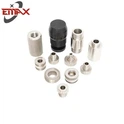
As a supplier of 304 stamping parts, I often encounter inquiries regarding the roundness requirements of these parts. Roundness is a critical geometric characteristic that can significantly impact the functionality, performance, and overall quality of 304 stamping parts. In this blog post, I will delve into the key aspects of roundness requirements for 304 stamping parts, including the definition of roundness, factors influencing roundness, measurement methods, and industry standards.
Definition of Roundness
Roundness refers to the degree to which a cross - section of a circular part conforms to a perfect circle. In the context of 304 stamping parts, roundness is crucial for parts such as washers, rings, and cylindrical components. A part with good roundness has a consistent radius around its circumference, while a part with poor roundness may have variations in radius, resulting in an out - of - round shape.
Factors Influencing Roundness
Material Properties
The material properties of 304 stainless steel play a vital role in determining the roundness of stamping parts. 304 stainless steel is known for its good formability, but variations in material hardness, grain structure, and thickness can affect the stamping process and ultimately the roundness of the parts. For example, if the material has uneven hardness, it may deform unevenly during stamping, leading to poor roundness.
Stamping Tooling
The quality and condition of the stamping tooling are also significant factors. Worn or damaged punches and dies can cause irregularities in the stamping process. If the cutting edges of the tooling are not sharp or if there are misalignments, the part may not be formed accurately, resulting in deviations from the desired roundness.
Stamping Process Parameters
Parameters such as stamping force, speed, and clearance between the punch and die can have a direct impact on roundness. Excessive stamping force may cause the material to flow unevenly, while improper clearance can lead to wrinkling or cracking, both of which can affect the roundness of the part.
Measurement Methods
Caliper Measurement
One of the simplest methods to measure roundness is using a caliper. A caliper can be used to measure the diameter of the part at multiple points around the circumference. By comparing these measurements, an approximation of the roundness can be obtained. However, this method has limitations in terms of accuracy, especially for parts with small tolerances.
Roundness Measuring Instruments
For more precise measurements, specialized roundness measuring instruments are used. These instruments, such as roundness testers, use a probe to measure the surface profile of the part. The data collected is then analyzed to determine the roundness error, which is typically expressed as the difference between the maximum and minimum radii of the part.
Industry Standards
There are several industry standards that define the roundness requirements for 304 stamping parts. For example, the American Society of Mechanical Engineers (ASME) has standards such as ASME Y14.5, which provides guidelines for geometric dimensioning and tolerancing, including roundness. International Organization for Standardization (ISO) also has relevant standards, such as ISO 1101, which specifies the general principles for geometric tolerancing, including roundness.
In the manufacturing of 304 stamping parts, it is essential to adhere to these standards to ensure the quality and interchangeability of the parts. Customers often have specific roundness requirements based on the application of the parts. For example, in the automotive industry, parts with high roundness accuracy are required for components such as bearings and pistons to ensure smooth operation and reduce wear.
Applications and Roundness Requirements
Automotive Industry
In the automotive industry, 304 stamping parts are widely used. For parts like engine components, the roundness requirements are extremely strict. Even a small deviation in roundness can lead to problems such as leakage, vibration, and reduced efficiency. For example, a piston ring made of 304 stainless steel needs to have a very high degree of roundness to ensure a proper seal in the engine cylinder.


Electronics Industry
In the electronics industry, 304 stamping parts are used in various applications, such as connectors and shielding components. The roundness requirements in this industry are also important, as proper roundness ensures a good fit and electrical conductivity. For example, a circular connector made of 304 stainless steel needs to have a precise roundness to ensure a reliable connection.
Our Approach as a Supplier
As a 304 stamping parts supplier, we take several measures to ensure that our parts meet the roundness requirements. Firstly, we carefully select high - quality 304 stainless steel materials from reliable suppliers. We conduct strict incoming material inspections to ensure the consistency of the material properties.
Secondly, we maintain our stamping tooling regularly. Our tooling is designed and manufactured with high precision to ensure accurate part formation. We also have a team of experienced toolmakers who can quickly repair or replace worn - out tooling.
In addition, we use advanced stamping equipment and optimize the stamping process parameters. We conduct extensive process simulations and trials to determine the optimal parameters for each part design. For roundness measurement, we have a well - equipped quality control laboratory with state - of - the - art roundness measuring instruments. Our quality control team conducts thorough inspections at every stage of the production process to ensure that the roundness requirements are met.
Related Products
We also offer a wide range of related products, such as Iron Stamping Parts and Galvanizing Stamping Steel Parts. These products are also manufactured with high precision and quality control to meet the diverse needs of our customers. One of our popular products is the Gibbon Display Stand GM112W, which is made of high - quality 304 stainless steel and has excellent roundness and surface finish.
Contact Us for Procurement
If you are in need of high - quality 304 stamping parts with strict roundness requirements, we are here to help. Our team of experts can work with you to understand your specific needs and provide customized solutions. Whether you are in the automotive, electronics, or other industries, we have the experience and capabilities to meet your requirements. Contact us today to start the procurement process and discuss how we can provide the best 304 stamping parts for your application.
References
- American Society of Mechanical Engineers (ASME). ASME Y14.5.
- International Organization for Standardization (ISO). ISO 1101.