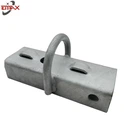
According to the difference in the structure of sheet metal parts, the process flow can be different, but the total does not exceed the following points.
1. Cutting: There are various cutting methods, mainly the following methods
① Shearing machine: It is a simple piece of material that uses a shearing machine to cut strips. It is mainly used to prepare and process the blanking of the mold. The cost is low, and the accuracy is less than 0.2, but it can only process strips or blocks with no holes and no corners. .
② Punch: It uses a punch to punch out the flat parts after unfolding the parts on the plate in one or more steps to form various shapes of materials. Its advantages are short man-hours, high efficiency, high precision, low cost, and it is suitable for mass production. , But to design the mold.
③ NC CNC blanking. When NC blanking, you must first write a CNC machining program. Use the programming software to program the drawn unfolded image into a program that can be recognized by the NC digital drawing processing machine, so that it can be punched on the plate step by step according to these programs. Flat pieces of various shapes, but the structure is determined by the tool structure, the cost is low, and the accuracy is less than 0.15.
④ Laser cutting is to use laser cutting to cut out the structure and shape of the flat plate on a large flat plate. The laser program is required to be programmed like NC cutting. It can load various complex shapes of flat parts with high cost and lower accuracy. 0.1.
⑤ Sawing machine: mainly use aluminum profiles, square tubes, drawing tubes, round bars, etc., with low cost and low precision.
2. Flanging: It is also called hole-drawing and hole-turning, which is to draw a slightly larger hole on a smaller base hole, and then tap it. It is mainly processed with thinner sheet metal to increase its strength and the number of threads. , To avoid sliding teeth, generally used for thin plate thickness, normal shallow flanging around the hole, the thickness is basically unchanged, and the thickness is allowed to be thinned by 30-40%, 40-higher than the normal flanging height can be obtained. For a height of 60%, the maximum flanging height can be obtained when the thinning is 50%. When the thickness of the plate is larger, such as 2.0, 2.5, etc., it can be tapped directly.
3. Punch: It is a processing procedure that uses mold forming. Generally, punching processing includes punching, corner cutting, blanking, punching convex hull (bump), punching and tearing, punching, forming and other processing methods. The processing needs to have corresponding processing methods. The mold is used to complete the operations, such as punching and blanking molds, convex molds, tearing molds, punching molds, forming molds, etc. The operation mainly pays attention to position and directionality.
4. Pressure riveting: pressure riveting mainly includes pressure riveting nuts, screws, and so on. It is completed by hydraulic pressure riveting machine or punching machine, riveting it to sheet metal parts, and there is a way of expanding riveting, which requires attention .
5. Bending: Bending is to fold 2D flat parts into 3D parts. The processing needs to be completed with a folding bed and corresponding bending molds, and it also has a certain bending sequence. The principle is that the next cut will not interfere with the first folding, and the interference will occur after the folding.