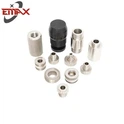
In the dynamic landscape of the industrial world, the Dead End Bracket, a seemingly simple yet indispensable component, plays a pivotal role in various sectors. As a supplier of Dead End Brackets, I've witnessed firsthand the far - reaching influence these products have on multiple industries. This blog post aims to explore the industries affected by Dead End Brackets and shed light on their significance.
Telecommunications Industry
The telecommunications industry is one of the primary sectors relying heavily on Dead End Brackets. In this industry, the efficient transmission of signals is of utmost importance. Telecommunication lines, including fiber - optic cables and copper wires, need to be securely installed and maintained to ensure uninterrupted communication. Dead End Brackets are used to anchor these cables at the end points of the poles or towers.
For instance, when setting up a long - distance telecommunication network, the cables are strung between poles. At the end of each section, Dead End Brackets are employed to terminate the cables firmly. This prevents the cables from sagging or coming loose due to external factors such as wind, rain, or temperature changes. Moreover, proper cable termination using Dead End Brackets helps in reducing signal loss, which is crucial for high - quality communication. A well - installed Dead End Bracket ensures that the cables maintain the correct tension, allowing for optimal signal transmission.
The Galvanizing Clamp Used For Telegraph Pole is often used in conjunction with Dead End Brackets in the telecommunications industry. These clamps provide additional support to the poles and help in securing the cables more effectively. They are typically made of galvanized materials to resist corrosion, which is essential in outdoor environments where the poles and cables are exposed to the elements.


Electrical Power Distribution Industry
In the electrical power distribution industry, Dead End Brackets are equally vital. Power lines carry high - voltage electricity from power plants to substations and then to consumers. The safety and reliability of these power lines are of the utmost concern. Dead End Brackets are used to terminate the power lines at the poles, transformers, and other electrical equipment.
At the end of a power line section, a Dead End Bracket is installed to hold the conductors in place. This is crucial for preventing the conductors from swinging or moving, which could lead to short - circuits or other electrical hazards. Additionally, Dead End Brackets help in maintaining the correct distance between the conductors, ensuring proper insulation and reducing the risk of electrical arcing.
The Electric Cross Arm Angle Pole is another important component in the electrical power distribution system. It is often used in combination with Dead End Brackets to support the power lines. The cross - arm provides a stable structure for mounting the Dead End Brackets and other hardware, allowing for a more organized and efficient power line installation.
Construction Industry
The construction industry also benefits from the use of Dead End Brackets. In large - scale construction projects, such as high - rise buildings and bridges, temporary power and communication systems are often required. Dead End Brackets are used to install and secure the cables for these temporary systems.
During the construction process, it is essential to have a reliable power supply for tools and equipment. Dead End Brackets are used to anchor the power cables to the scaffolding or other structures, ensuring that the power lines are safely installed and do not pose a risk to the workers. Similarly, for communication systems on the construction site, Dead End Brackets help in securing the cables, allowing for seamless communication between different teams.
In addition, in the construction of permanent structures, Dead End Brackets can be used in the installation of electrical and communication systems within the building. They are used to terminate the cables at the distribution boards and other electrical equipment, ensuring a safe and reliable connection.
Transportation Industry
The transportation industry, particularly the railway and subway systems, also makes use of Dead End Brackets. In railway systems, electrical power is required to operate the trains, signals, and other equipment. Dead End Brackets are used to install and secure the overhead power lines, known as catenary systems.
The catenary system needs to be precisely installed to ensure a continuous supply of power to the trains. Dead End Brackets are used to terminate the power lines at the end of each section of the track, maintaining the correct tension and alignment of the cables. This is crucial for the smooth operation of the trains, as any disruption in the power supply can lead to delays and safety issues.
In subway systems, Dead End Brackets are used in the installation of communication and control cables. These cables are responsible for transmitting signals between the trains, stations, and control centers. By using Dead End Brackets to secure the cables, the subway system can ensure reliable communication and control, which is essential for the safe and efficient operation of the trains.
Marine Industry
The marine industry also has a need for Dead End Brackets. In ships and offshore platforms, electrical and communication systems are essential for navigation, safety, and operation. Dead End Brackets are used to install and secure the cables on these vessels and platforms.
In a ship, there are numerous electrical and communication cables that need to be properly installed and maintained. Dead End Brackets are used to terminate the cables at the distribution panels, control rooms, and other equipment. They help in preventing the cables from being damaged due to vibrations, movement, and the harsh marine environment.
On offshore platforms, such as oil rigs, Dead End Brackets are used in the installation of power and communication systems. These platforms are exposed to extreme weather conditions, including high winds, waves, and saltwater corrosion. Dead End Brackets made of corrosion - resistant materials are used to ensure the long - term reliability of the electrical and communication systems. The Cable Clamps Guy or Suspension can be used in conjunction with Dead End Brackets in the marine industry to provide additional support to the cables.
Conclusion
As a supplier of Dead End Brackets, I've seen how these products are integral to the smooth operation of various industries. From telecommunications and electrical power distribution to construction, transportation, and the marine industry, Dead End Brackets play a crucial role in ensuring the safety, reliability, and efficiency of different systems.
The importance of using high - quality Dead End Brackets cannot be overstated. A sub - standard bracket can lead to cable failures, electrical hazards, and communication disruptions, which can have significant consequences for businesses and consumers alike. That's why it's essential to choose a reliable supplier who can provide Dead End Brackets that meet the highest quality standards.
If you're in need of Dead End Brackets for your industry, I invite you to reach out for a procurement discussion. We can work together to find the right solutions for your specific requirements. Whether you need a small quantity for a local project or a large - scale supply for a major infrastructure development, we're here to assist you.
References
- Electrical Power Systems Handbook, John Wiley & Sons
- Telecommunications Engineering Principles, Prentice Hall
- Construction Management: Principles and Practice, McGraw - Hill
- Marine Electrical Systems: Design, Installation, and Maintenance, Elsevier